
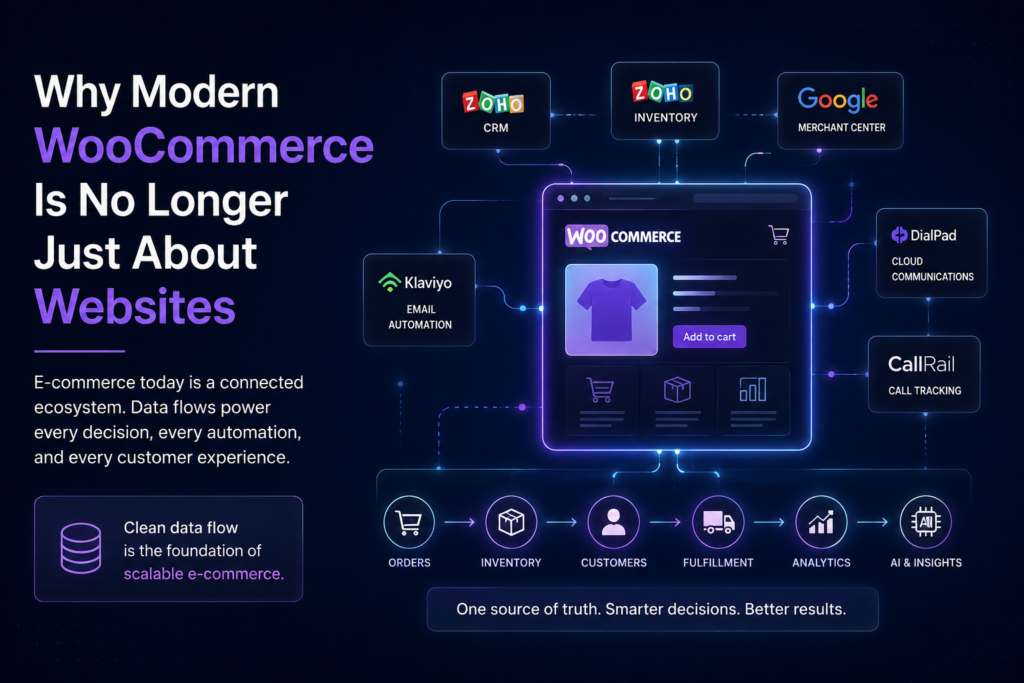
One thing that becomes very clear when working on large-scale e-commerce systems:
Most business problems are not caused by missing features.
They are caused by disconnected data.
Right now I’m working on an enterprise e-commerce infrastructure project where one of the biggest challenges is aligning data across WooCommerce, Zoho, Google Merchant Center, Klaviyo, DialPad, and CallRail.
At first glance, these sound like “just integrations”.
But in reality, they define how the entire business operates.
If WooCommerce and Zoho are not synchronized properly, you end up with multiple sources of truth. Orders, fulfillment, returns, and inventory stop telling the same story.
If CRM and inventory systems drift apart, purchasing decisions become reactive instead of intelligent.
If Google Merchant Center rejects products because of missing or invalid attributes, visibility disappears — and with it, traffic, attribution data, and revenue opportunities.
If customer calls and touchpoints don’t attach correctly to CRM profiles, marketing automation treats real customers like cold leads.
And perhaps the most interesting part:
modern collection pages are no longer “just pages”.
They are behavioral data streams.
Every browse action, filter, and add-to-cart event becomes a signal that feeds inventory planning, pricing logic, attribution systems, and future automation layers.
The deeper I go into enterprise WooCommerce architecture, the more I realize:
Clean data flow is the foundation of scalable e-commerce.
Not themes.
Not plugins.
Not dashboards.
Data alignment.
Over the next weeks, I’ll be publishing a series of posts exploring these problems in depth — based on real engineering experience, real operational challenges, and the systems architecture behind modern WooCommerce businesses.
I’ll break down topics like:
- multiple sources of truth
- CRM and inventory synchronization
- Google Merchant Center failures
- marketing automation gaps
- behavioral data collection
- scalable WooCommerce infrastructure
- enterprise commerce operations
Because modern WooCommerce is no longer just about websites.