
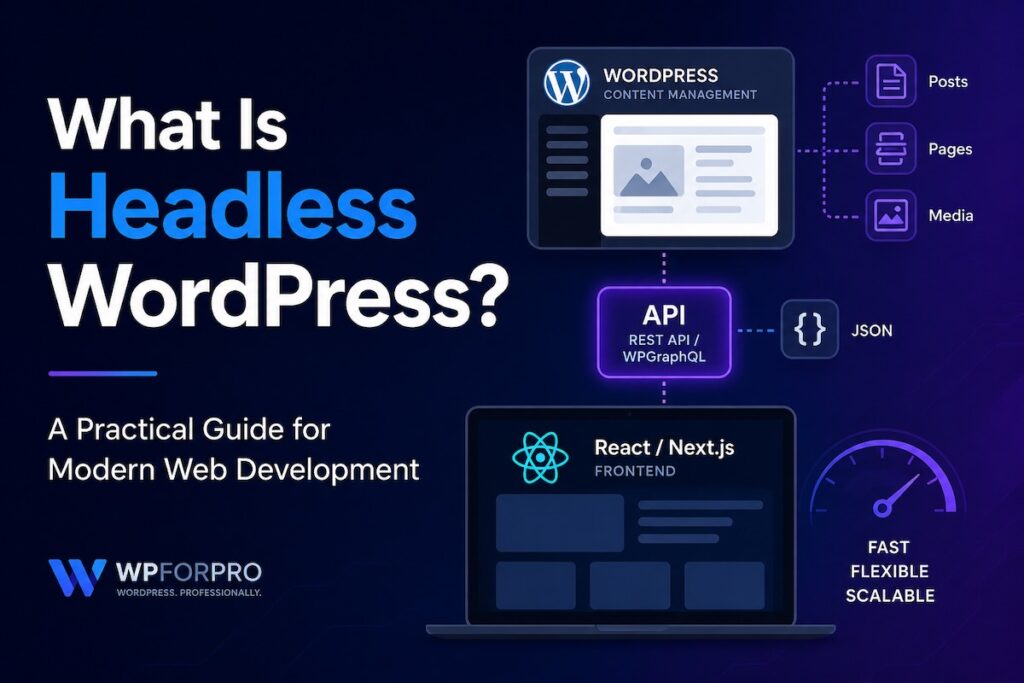
WordPress powers a significant portion of the web, largely because it combines content management, frontend rendering, and an extensive plugin ecosystem into a single platform.
For many projects, this traditional approach works exceptionally well.
However, as web applications become more complex and businesses demand greater flexibility, developers increasingly adopt a different architecture known as Headless WordPress.
In this guide, we’ll explore what Headless WordPress is, how it works, its advantages and challenges, and when it makes sense to choose it over a traditional WordPress setup.
What Is Headless WordPress?
In a traditional WordPress installation, the backend and frontend are tightly connected:
- WordPress stores content.
- WordPress processes business logic.
- WordPress renders pages using PHP themes.
- Visitors interact directly with WordPress-generated pages.
With Headless WordPress, the frontend is separated from the backend.
WordPress remains responsible for content management, while a separate application handles presentation and user interactions.
The architecture typically looks like this:
Content Editors
       │
       ▼
 WordPress Admin
       │
       ▼
REST API / WPGraphQL
       │
       ▼
 React / Next.js / Vue
       │
       ▼
      Users
In this setup, WordPress acts primarily as a content management system and API provider.
Traditional WordPress vs Headless WordPress
| Traditional WordPress | Headless WordPress |
|---|---|
| PHP-based themes | React, Next.js, Vue, Astro |
| Backend and frontend coupled | Backend and frontend separated |
| Faster project setup | Higher development complexity |
| Strong plugin compatibility | Requires custom integrations |
| Easier content previews | Preview workflows require additional setup |
| Lower development costs | Higher initial investment |
| Ideal for most websites | Ideal for specialized applications |
Neither approach is universally better.
The best choice depends on business requirements, scalability goals, and development resources.
How Headless WordPress Works
The key principle behind Headless WordPress is API-driven content delivery.
Content creators continue working in the familiar WordPress dashboard:
- Pages
- Posts
- Custom Post Types
- Taxonomies
- Advanced Custom Fields
- Media Library
Instead of rendering content through a WordPress theme, the frontend application retrieves data through:
- WordPress REST API
- WPGraphQL
- Custom APIs
The frontend then generates pages independently.
For example:
- An editor publishes a blog post in WordPress.
- The frontend requests content through an API.
- React or Next.js renders the page.
- Users receive the final content without WordPress generating the HTML directly.
Benefits of Headless WordPress
1. Improved Frontend Performance
Modern frontend frameworks often deliver faster user experiences.
Technologies such as Next.js support:
- Static Site Generation (SSG)
- Incremental Static Regeneration (ISR)
- Server-Side Rendering (SSR)
- Edge Rendering
These techniques can significantly improve loading times and Core Web Vitals.
2. Greater Flexibility
Frontend developers are no longer limited to PHP themes.
Teams can build interfaces using:
- React
- Next.js
- Vue
- Nuxt
- Astro
- Svelte
This allows organizations to adopt modern frontend ecosystems while retaining WordPress as their content platform.
3. Omnichannel Content Delivery
A single WordPress installation can serve content to multiple platforms:
- Websites
- Mobile applications
- Customer portals
- Digital kiosks
- Internal tools
- Smart devices
Content becomes reusable across multiple channels.
4. Easier Integration With External Systems
Many enterprise projects require integration with:
- CRMs
- ERPs
- Marketing platforms
- Inventory systems
- Analytics tools
- AI services
Headless architectures often simplify these integrations because APIs become the central communication layer.
5. Independent Development Teams
Backend and frontend teams can work separately.
Content management can evolve independently from frontend implementation, improving development workflows in larger organizations.
Challenges and Trade-Offs
Headless WordPress introduces significant benefits, but also additional complexity.
Increased Development Complexity
Instead of managing one application, developers maintain:
- WordPress backend
- API layer
- Frontend application
- Deployment pipelines
- Caching infrastructure
This increases operational overhead.
More Expensive Development
Headless projects often require expertise in:
- WordPress development
- JavaScript frameworks
- API architecture
- DevOps
- Hosting infrastructure
Development costs are usually higher compared to traditional WordPress projects.
Preview Workflows
Content previews are straightforward in traditional WordPress.
In headless setups, preview functionality often requires custom implementation between WordPress and the frontend application.
Plugin Compatibility
Many plugins assume WordPress controls frontend rendering.
Features such as:
- Page builders
- Dynamic widgets
- Frontend shortcodes
may require additional work or alternative solutions.
SEO Considerations
Headless WordPress can achieve excellent SEO performance.
However, developers must explicitly manage:
- Metadata
- Structured data
- XML sitemaps
- Open Graph tags
- Canonical URLs
Modern frameworks like Next.js provide tools for handling these requirements effectively.
REST API vs WPGraphQL
Most Headless WordPress projects rely on one of two approaches.
WordPress REST API
Built directly into WordPress.
Advantages:
- No additional plugins required
- Widely supported
- Easy to understand
Limitations:
- Multiple requests may be needed
- Over-fetching data is common
WPGraphQL
WPGraphQL has become a popular choice for modern headless projects.
Advantages:
- Fetch only required data
- More efficient queries
- Better frontend developer experience
- Excellent integration with React ecosystems
Limitations:
- Additional plugin dependency
- Learning curve for GraphQL concepts
For complex applications, many developers prefer GraphQL because of its flexibility and efficiency.
When Headless WordPress Makes Sense
Headless WordPress is often a strong choice for:
Enterprise Websites
Organizations with complex business requirements and multiple integrations.
High-Traffic Marketing Platforms
Projects where performance and scalability are critical.
SaaS Products
Applications that combine content management with custom frontend experiences.
Multi-Channel Publishing
Businesses distributing content across multiple digital platforms.
React-Based Ecosystems
Teams already invested in React, Next.js, or similar technologies.
When Traditional WordPress Is the Better Choice
Despite growing interest in headless architectures, traditional WordPress remains the best solution for many projects.
Examples include:
- Company websites
- Personal blogs
- Small business websites
- Most WooCommerce stores
- Marketing websites with limited complexity
- Projects with tight budgets
In many cases, traditional WordPress delivers faster development, lower maintenance costs, and excellent business outcomes.
A Practical Perspective
One of the most common misconceptions is that Headless WordPress automatically creates a better website.
In reality, architecture should solve business problems.
If a traditional WordPress implementation meets performance, scalability, and maintenance requirements, introducing a headless architecture may add unnecessary complexity.
Conversely, when projects require advanced frontend experiences, multiple integrations, or omnichannel content delivery, Headless WordPress can provide a powerful foundation for long-term growth.
The goal is not to follow trends.
The goal is to choose the architecture that best serves the business.
The Future of Headless WordPress
Several trends continue driving adoption:
- Growth of React and Next.js ecosystems
- Increased use of APIs across applications
- Composable architecture patterns
- AI-powered content workflows
- Enterprise digital experience platforms
WordPress remains one of the most flexible content management systems available, and its API capabilities make it well-positioned for modern application architectures.
Final Thoughts
Headless WordPress is not a replacement for traditional WordPress.
It is an architectural approach that separates content management from frontend presentation, providing greater flexibility, scalability, and integration opportunities for the right projects.
For enterprise applications, high-performance platforms, and API-driven ecosystems, Headless WordPress can be an excellent solution.
For many websites, however, traditional WordPress remains the most practical, cost-effective, and maintainable choice.
Understanding the strengths and trade-offs of both approaches allows developers and businesses to make informed decisions based on real requirements rather than industry trends.